

When it comes to charging devices, the world often feels like a tangled web of cables and adapters. Enter the iPhone 15 and the MacBook charger—two tech giants that might just be the perfect match. But can they really get along? Imagine the convenience of using one charger for multiple devices. It’s like finding out that your favorite pizza place also serves gourmet tacos.
Overview of Charging Compatibility
Charging compatibility between the iPhone 15 and a MacBook charger simplifies the user experience. Using a single charger for multiple devices like iPhones and MacBooks reduces clutter. Apple designs its chargers to work interchangeably with various products, promoting versatility.
The iPhone 15 supports USB-C charging, aligning with MacBook charger specifications. Charging an iPhone 15 with a MacBook charger provides efficient power delivery. Different wattages result in different charge times. For example, a 30W MacBook charger charges an iPhone 15 faster than a standard 5W charger.
Utilizing a MacBook charger for an iPhone 15 doesn’t pose safety risks. Apple incorporates smart technology within its chargers to prevent overheating or charging issues. Many users find this dual-use capability beneficial during travel or busy workdays.
Compatibility extends to various USB-C accessories. Connecting an iPhone 15 to other USB-C devices continues to be seamless. This flexibility allows users to charge their devices with convenience and ease.
Choosing the right wattage depends on charging needs. While lower wattage chargers work, higher wattage options reduce charging times significantly. Users must consider what fits their usage patterns best.
Overall, charging an iPhone 15 with a MacBook charger offers functionality and versatility, eliminating the need for multiple chargers. The technology behind these devices supports efficient power transfer, ensuring users enjoy a streamlined experience.
Understanding MagSafe and USB-C Charging
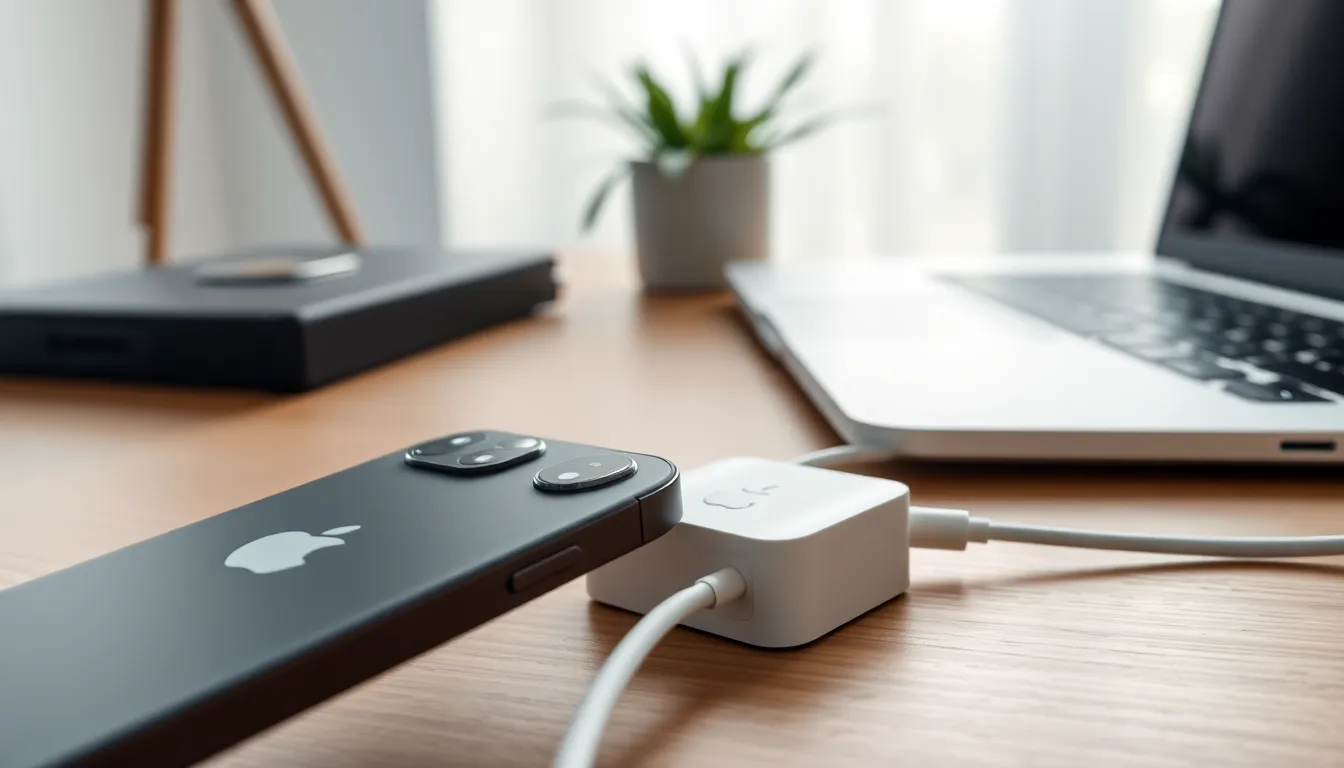
iPhone 15 and MacBook chargers engage with modern charging technology effectively. USB-C compatibility stands as a vital feature for both devices, creating a seamless user experience.
Differences Between iPhone and MacBook Chargers
iPhone chargers typically provide lower wattage compared to MacBook chargers. A standard 5W charger supports basic functions, whereas a MacBook charger can deliver 30W or more. Differences in wattage affect charging speed, meaning the iPhone 15 charges much faster with a MacBook charger. Charger connectors also vary; while the iPhone 15 exclusively uses USB-C, some MacBooks feature MagSafe connectors. These separate connector types do not impact the ability to utilize a MacBook charger for the iPhone 15, streamlining device usage.
Benefits of Using a MacBook Charger
Using a MacBook charger for an iPhone 15 offers several advantages. Faster charging times stand out as a primary benefit, as higher wattage significantly reduces the wait. Convenience emerges for users with multiple devices, eliminating the need for separate chargers. The versatility of a single charger simplifies daily routines, especially during travel. Enhanced safety features within Apple’s design protect against overheating and power surges, ensuring a safe charging experience. Moreover, compatibility with various USB-C accessories enhances the overall functionality of user setups.
Charging Speed and Efficiency
Charging the iPhone 15 with a MacBook charger offers impressive speed and efficiency. The combination of USB-C technology and robust wattage options enables faster charging times compared to standard chargers.
How Fast Can iPhone 15 Charge With a MacBook Charger?
Using a 30W MacBook charger, the iPhone 15 can reach up to approximately 50% charge in about 30 minutes. This contrasts with a traditional 5W charger, which may take several hours to fully charge the device. The iPhone 15 benefits from quick top-ups during busy days, making it an efficient option for users on the go.
Factors That Affect Charging Speed
Multiple factors influence charging speed with a MacBook charger. The wattage of the charger plays a significant role; higher wattages lead to faster charges. The condition of the charging cable also matters, as damaged cables can slow down the charging process. Additionally, ambient temperature affects charging rates; extreme cold or heat can hinder efficiency. Lastly, background activity on the iPhone can influence charging speeds, as apps consuming power may prolong the time it takes to reach full charge.
Safety Considerations
Charging an iPhone 15 with a MacBook charger is generally safe due to Apple’s design and technology. Apple incorporates safety features to manage overheating and voltage levels effectively. Users can confidently leverage the compatibility since the iPhone 15 accepts USB-C connections, which aligns perfectly with MacBook chargers. This compatibility allows charging without risking device safety.
Is It Safe to Use a MacBook Charger for iPhone 15?
Using a MacBook charger for the iPhone 15 proves to be safe. Apple’s chargers feature built-in mechanisms to prevent overloading and overheating during the charging process. With the ability to handle different wattages, the charger adjusts power delivery automatically, ensuring optimal safety. Therefore, it becomes a practical solution for users with multiple Apple devices.
Potential Risks and Precautions
While generally safe, some risks exist when using a MacBook charger with an iPhone 15. Users may face potential damage if using non-certified cables or third-party chargers. Keeping the charging environment clean and dry minimizes risks as well. Monitoring charger temperatures during prolonged use ensures safety. Taking these precautions enhances the overall charging experience while maintaining device integrity.
User Experiences and Feedback
Users report a positive experience when charging their iPhone 15 with a MacBook charger. Faster charging times stand out, with many noting that they achieve around 50% charge within 30 minutes using a 30W charger. This efficiency significantly reduces downtime compared to traditional 5W chargers, which can take hours to provide comparable power.
Some individuals appreciate the reduced clutter, particularly those managing multiple devices. Using one charger for both an iPhone and a MacBook simplifies travel and daily routines. Feedback indicates that this versatility enhances the overall user experience, especially for those who often switch between devices.
Safety concerns frequently surface in discussions. Many users express confidence, knowing Apple designs its products to prevent overheating and other charging issues. Built-in safety features reassure users that charging with higher wattage is safe and practical.
Users also share insights regarding charging performance in different environments. Factors like cable condition and ambient temperature noticeably impact charging efficiency. Some have indicated that maintaining a clean and dry charging space further enhances device performance.
While most highlight the compatibility benefits, a few mention a cautious approach when using third-party chargers or non-certified cables. Such practices align with Apple’s push for certified accessories to ensure safety and reliability. Overall feedback reinforces the idea that combining the iPhone 15 and MacBook charger streamlines the charging process, providing convenience and peace of mind.
Charging the iPhone 15 with a MacBook charger proves to be a practical solution for many users. The compatibility not only streamlines the charging process but also enhances convenience for those juggling multiple devices. With faster charging times and the safety features built into Apple’s technology, users can confidently power up their devices without worry.
This dual-use capability significantly reduces clutter and simplifies daily routines, especially for those on the go. Embracing this compatibility allows for a more efficient and enjoyable user experience, making it easier to stay connected throughout the day.